
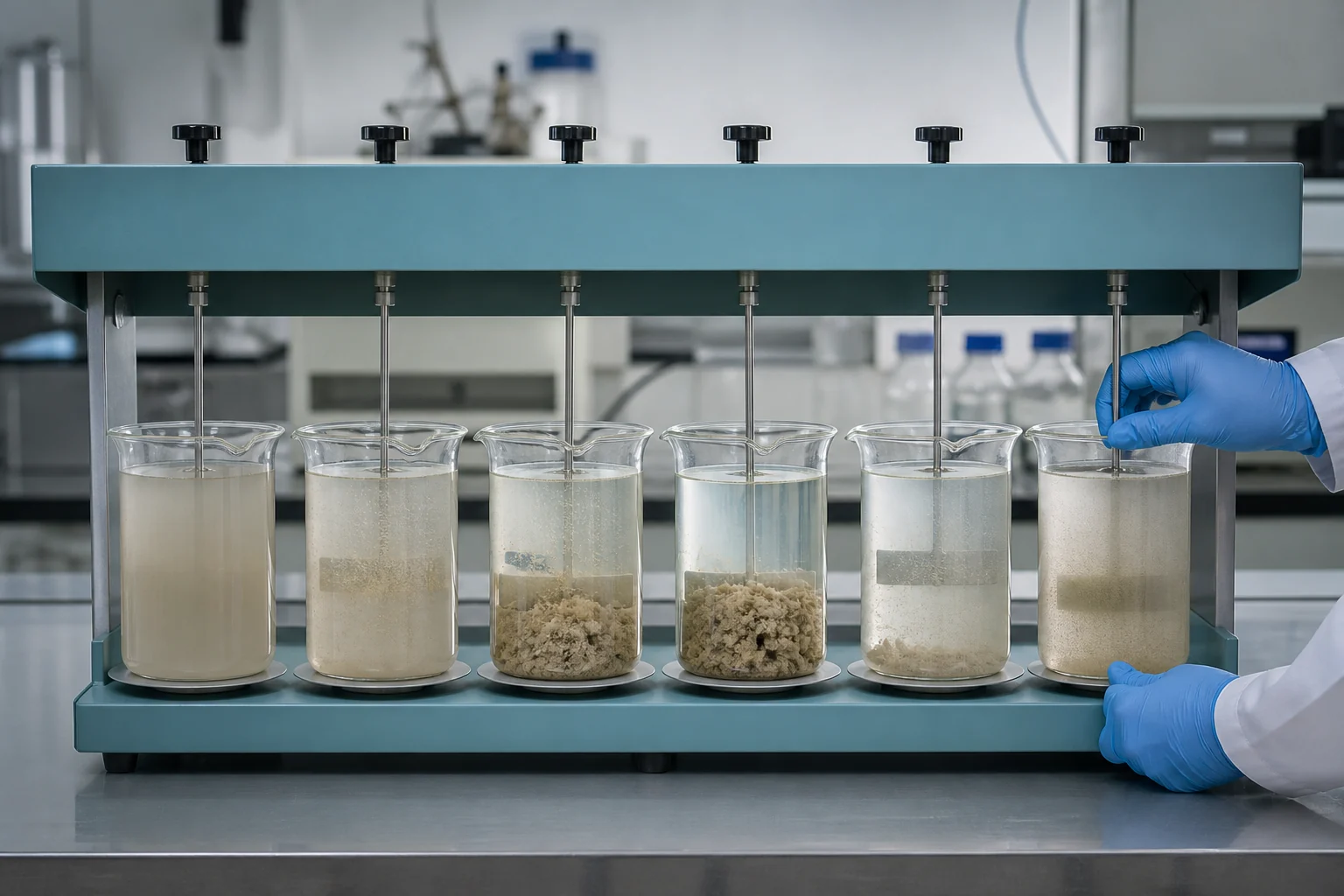
Jar testing helps eliminate unsuitable polyacrylamide flocculant grades, but it does not replace a controlled plant trial. Use the actual process water, reproduce realistic dilution and compare a dose curve rather than one favored dose.
Keep the test comparable
Prepare each polymer using the same water, concentration, aging time and mixing method. Record the product lot and solution age. For dry PAM, poor wetting can make an appropriate grade look weak before it ever reaches the sample.
Measure the result that matters
For clarification, track settling velocity, supernatant turbidity, floc strength and sludge compaction. For dewatering, carry promising grades into equipment trials and record capture, cake solids, filtrate quality and active dose.
Build a dose-response curve
Run a blank sample and at least four polymer doses that bracket the expected operating range. Add identical polymer-solution volumes at the same point in the mixing cycle. Record when visible floc first forms, how it responds to gentle mixing and whether it remains intact after transfer or settling. A grade that works at only one narrow dose is usually harder to control in a variable plant.
For mineral suspensions, useful observations include initial settling velocity, interface definition, overflow turbidity and final bed volume. For organic sludge, note filtrate or centrate clarity, floc resilience and whether the conditioned solids release water without becoming sticky. Always compare active polymer dose rather than prepared-solution volume alone.
Watch for misleading results
Residual coagulant, recycled process water, temperature and sample age can change the ranking of candidates. Freshly collected samples are preferable. If plant water is saline or contains oil, iron or surfactants, do not prepare every polymer in clean tap water and assume the result will transfer.
Overdose can produce floating floc, hazy water, sticky solids or slower compaction. Underdose leaves fines dispersed and creates fragile floc. Record both failure patterns so operators know the usable window, not merely the best-looking beaker.
Use the test to plan a trial
Select a small number of candidates with a practical operating window. The objective is not to produce the clearest beaker at any cost; it is to identify a grade that can be prepared, dosed and controlled reliably at plant scale.
Translate beaker results into plant settings
For each finalist, convert the laboratory dose into active polymer per tonne of dry solids or per cubic metre of feed. Check the plant's stock concentration and pump range, then select an injection rate that can actually be controlled. If the calculated setting sits at the extreme end of the pump, the trial may need a different solution concentration.
Reproduce the expected contact sequence as closely as practical. The plant trial should begin at a conservative dose, stabilize long enough for downstream samples to represent the new condition, and then move through planned steps. Record flow, solids, polymer preparation, dose and performance at every stable point.
Decide with repeatable data
Repeat promising tests on fresh samples and, where possible, on different operating days. A single test can be biased by unusual feed, residual chemicals or solution-preparation error. Keep a retained polymer sample and a short written method so another technician can reproduce the comparison.
Use the results to define an operating window rather than a fixed number. Normal changes in solids, temperature and upstream chemistry will move the optimum dose. The selected grade should tolerate these changes without sudden loss of clarity, capture or dewatering performance.
Information to send with the result
Share photos, dose tables, preparation details and the original feed description with the supplier. Include which failure mode occurred at underdose and overdose. The technical team at Gongyi Xinqi Polymer can use that evidence to refine charge density or molecular-weight choices before the full-scale trial.