
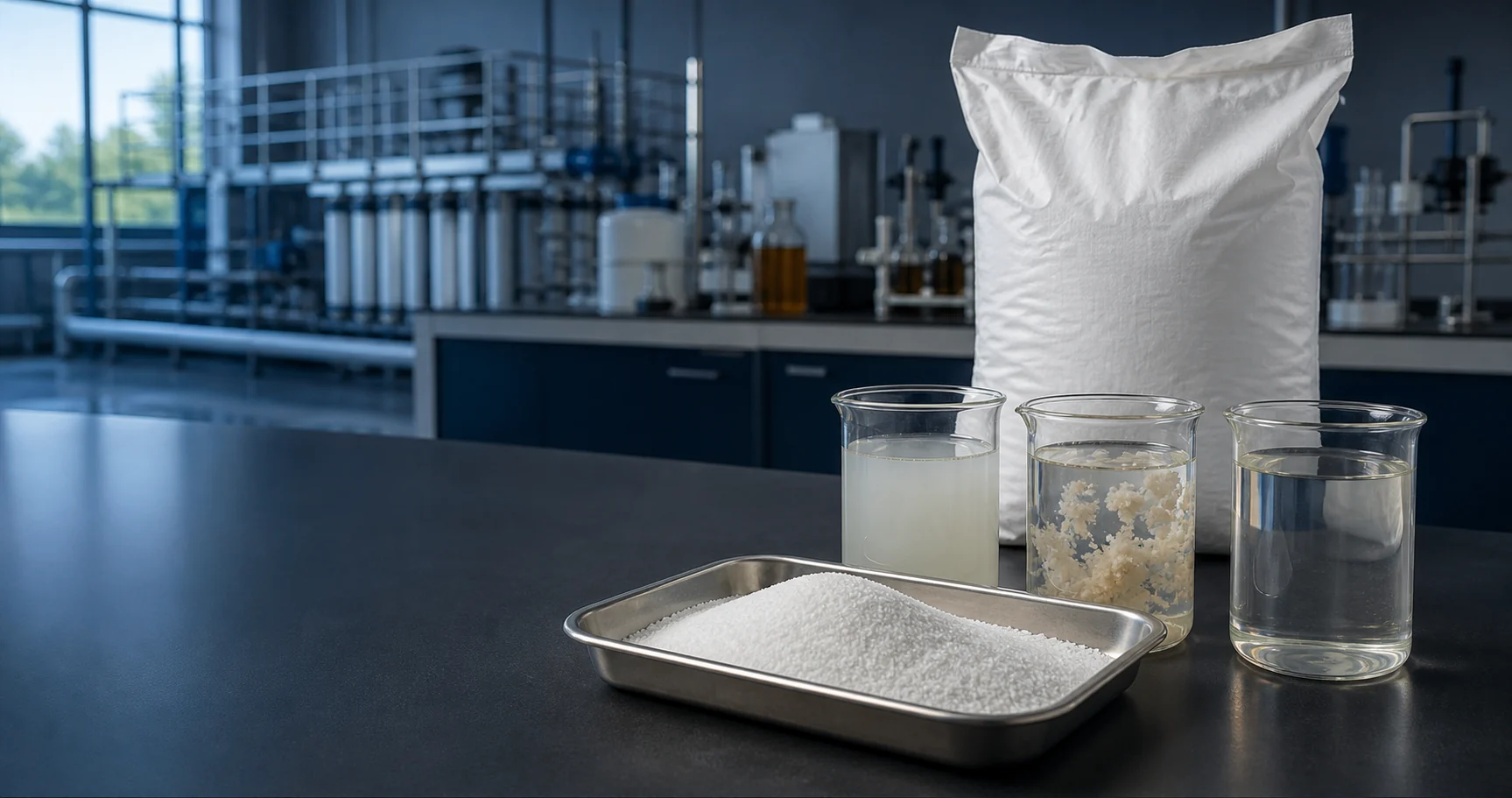
The practical difference in PAC vs polyacrylamide is that polyaluminium chloride is primarily an inorganic coagulant, while PAM is a high-molecular-weight flocculant. PAC destabilizes fine colloids through charge neutralization and sweep coagulation. Polyacrylamide bridges destabilized particles into larger flocs that can settle, float or dewater more effectively.
What PAC does
PAC hydrolyses in water and forms positively charged aluminium species. It can reduce colloidal stability, capture colour and create metal-hydroxide precipitates. Its performance depends strongly on dose, pH and alkalinity. Excessive PAC can depress pH, increase sludge production or reverse charge.
What polyacrylamide does
Cationic, anionic and nonionic PAM products provide different charge and bridging behavior. PAM is normally used at a much lower active dose than an inorganic coagulant. It enlarges particles and improves separation but cannot automatically correct unsuitable coagulation chemistry. Review the polyacrylamide flocculant application guide for common duties.
When PAC and PAM are used together
Industrial wastewater, DAF, raw-water clarification and some mineral streams may benefit from sequential treatment. PAC is fast-mixed first to destabilize colloids. Dilute PAM is then added under gentler mixing to build floc. The required delay and mixing energy depend on the process. Adding both at the same point can waste polymer or create fragile floc.
When PAM may be used without PAC
Some mineral suspensions already have suitable surface chemistry for direct anionic bridging. Sludge dewatering often uses cationic PAM as the principal conditioner. The need for PAC must be demonstrated by testing; it should not be added merely because the existing polymer appears weak.
Compare the complete treatment programme
- Effluent turbidity, colour, COD or oil
- Settling or flotation behavior
- Sludge volume and dewaterability
- Final pH and alkalinity consumption
- Total chemical cost per cubic metre
Run a matrix that varies PAC dose first, then tests several PAM doses at the strongest coagulation conditions. Avoid changing every variable at once. The DAF polymer selection guide provides equipment-specific checkpoints.
Ask the water treatment polymer product team for PAM samples based on the actual wastewater and current coagulant programme. For high-organic sludge and wastewater, the cationic polyacrylamide resource provides additional grade context.
Questions to answer before replacing either chemical
Determine whether the present failure is colloid destabilization, insufficient bridging, poor mixing or overloaded separation equipment. A streaming-current or zeta-potential result can support coagulation work, while settling, flotation and dewatering tests show whether the resulting floc performs mechanically. Do not replace PAC with PAM on price alone because they are not direct equivalents.
Record chemical product strength as well as delivered price. Liquid PAC concentrations and PAM active content vary, so treatment cost must be normalized to the dose that achieves the required water and sludge result.
Optimize pH and mixing before final comparison
PAC consumes alkalinity and may move the system outside its useful coagulation range. Measure pH after addition, not only in raw water. Provide intense short mixing for PAC, then gentler contact for PAM. If polymer is added before colloids are destabilized, the plant may use more product while forming floc that breaks easily.
In procurement records, list commercial concentration, active dose, freight and resulting sludge volume. The lowest price per tonne is not necessarily the lowest treatment cost. Include water-quality limits and sludge-handling results in the approval criteria so either chemical cannot be substituted solely on a name or generic specification.
Minimum test matrix
Run untreated control samples, then establish a PAC curve at controlled pH. At two or three useful PAC points, compare several PAM doses and at least two suitable ionic grades. Record water quality, floc strength, sludge volume and active chemical cost. This staged matrix identifies whether improvement comes from coagulation, bridging or both and avoids selecting a combination from one visually attractive jar.