
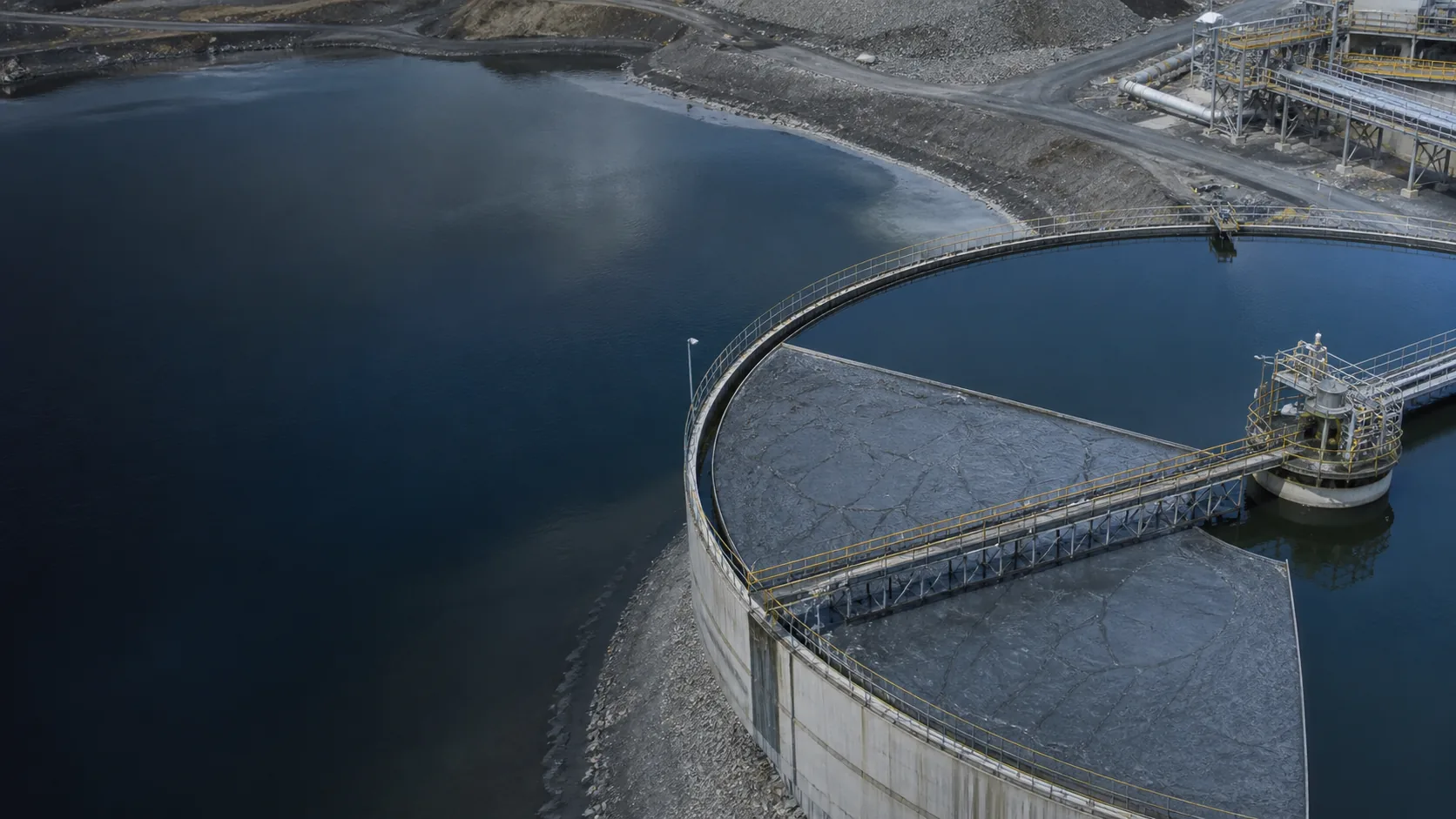
A polyacrylamide flocculant for mining must create fast, controllable solid-liquid separation without sacrificing overflow clarity or underflow density. Anionic polyacrylamide is a common starting family for mineral suspensions, but ore type, clay content, pH, dissolved salts and upstream reagents determine which hydrolysis level and molecular-weight range actually works.
Define the thickener or clarifier objective
High initial settling velocity is useful, but it is not the only target. A tailings thickener also needs a defined interface, clear overflow, compact underflow and stable rake operation. Process-water clarification may prioritize turbidity and recycle-water quality. Filtration circuits may care more about permeability and final moisture than rapid settlement.
Use the anionic polyacrylamide flocculant guide to understand the product family before requesting site-specific samples.
Mineralogy and water chemistry change the result
Fine clays often dominate flocculant demand even when they represent a small fraction of the total solids. Calcium, magnesium, salinity, dispersants and residual coagulants can alter polymer adsorption. Test with representative slurry and actual make-down water. A synthetic laboratory suspension or clean tap water can produce a ranking that does not transfer to the plant.
Control preparation and addition
Dry PAM must be wetted gradually, hydrated fully and transferred with limited shear. The injection point needs enough mixing to contact the solids but must avoid destroying formed floc. Compare dose as active polymer per tonne of dry solids rather than pump speed or solution volume. Split dosing can help some variable feeds, but it should be proven with controlled trials.
Record a complete dose-response curve
- Initial and zone settling velocity
- Overflow turbidity after a fixed time
- Floc size and resistance to shear
- Final bed volume and underflow density
- Rake torque, throughput and active dose
Shortlist grades that give a broad stable window, not merely one impressive beaker. Then run a continuous trial across normal feed variability. The site’s jar-test comparison guide provides a repeatable screening sequence.
For related mineral-processing information, see this anionic polyacrylamide resource. When contacting a PAM flocculant supplier, include ore or clay type, solids concentration, pH, existing reagent programme, equipment and target throughput.
Plan for feed variation and scale-up
A useful mining trial includes normal ore, clay-rich feed and recycled-water conditions. Laboratory cylinders can rank candidates, but a dynamic thickener trial is needed to observe feedwell mixing, bed level, torque and underflow pumping. Take paired overflow and underflow samples at stable intervals instead of relying on visual observation.
Purchasing specifications should define the tested product range and performance basis without assuming that nominal molecular weight alone guarantees equivalence. Confirm packaging, moisture protection, lot documentation and the supplier’s process for checking replacement batches.
Distinguish polymer failure from thickener constraints
Cloudy overflow can come from short residence time, poor feedwell energy dissipation, bed-level instability or an abrupt clay increase. A higher dose may temporarily hide the cause while increasing underflow viscosity. Review hydraulic loading and slurry data with polymer results. When floc breaks after a pump or launder, relocation or staged dilution may be more effective than a higher-molecular-weight grade.
Calculate delivered treatment cost using active dose, throughput and water recovery. Supplier comparisons should include dissolution behavior, batch consistency, technical documentation and the ability to reproduce the approved sample at commercial scale.
Final RFQ checklist
Identify the mineral or ore, clay fraction, slurry solids, pH, conductivity, process water source, existing reagents, thickener dimensions and target overflow and underflow results. Include normal and peak throughput, current dose and destination. If slurry cannot be shipped, provide recent settling data and a clear trial protocol so sample selection is based on evidence rather than a generic mining label.